
kJ to Cal Converter: Instant Kilojoules to Calories Calculator
kJ to Calories Converter
Results update as you type. 1 kcal = 4.184 kJ
Enter any kilojoule value above to use this kJ to cal calculator instantly. On Australian food labels, energy is always displayed in kilojoules, but most diet apps like MyFitnessPal, Cronometer, and Lose It! track energy in calories. This calorie converter uses the official FSANZ nutritional formula, so every result matches exactly what you see on your nutrition panel.
Quick answer: 1 kJ = 0.239 kcal | 1 kcal = 4.184 kJ
kJ to Cal Formula And How to Convert Cal to kJ
Understanding the kJ to cal formula removes all guesswork when reading an Australian nutrition panel.
To convert kJ to calories (kcal):
kcal = kJ × 0.239006
To convert cal to kJ, use the cal to kJ formula:
kJ = kcal × 4.184
The kJ to calories conversion factor is 0.239006, and 1 cal to kJ equals 4.184 kJ. Both formulas follow the Food Standards Australia New Zealand (FSANZ) standard, the same conversion used on nutrition panels at Woolworths, Coles, Aldi and IGA.
How to work out kilojoules to calories manually: Take any kJ number from a food label and multiply by 0.239. Example: 800 kJ × 0.239 = 191 kcal. To reverse the conversion of cal to kJ, multiply your calorie figure by 4.184. You can also use the cal to kJ calculator above for instant results.
kJ to Calorie Conversions
500 kJ to Calories
500 kJ = 119.5 kcal Roughly the energy in a medium apple or a 200ml glass of orange juice. A snack at this level is considered low-energy by Australian dietary standards. To calculate: 500 ÷ 4.184 = 119.5 kcal.
1,000 kJ to Calories
1,000 kJ = 239 kcal About the same as a banana with a small tub of yoghurt, or two Weet-Bix with milk. When you see 1,000 kJ on a label, that is 239 food calories in any diet app. Quick check: 1,000 ÷ 4.184 = 238.9, rounded to 239 kcal.
1,500 kJ to Calories
1,500 kJ = 358.6 kcal A typical light lunch is a chicken salad sandwich or a small bowl of pasta. At 1,500 kJ, a meal uses about 17% of the average adult woman’s daily energy budget of 8,700 kJ (NHMRC).
2,000 kJ to Calories
2,000 kJ = 478 kcal The energy in a standard meal of rice with stir-fried vegetables and chicken. MyFitnessPal’s default daily target is 2,000 kcal (8,368 kJ), so 2,000 kJ is roughly one quarter of that daily target.
2,400 kJ to Calories
2,400 kJ = 573.6 kcal, a common amount for a substantial lunch or a post-workout meal. At 2,400 kJ, you are consuming roughly 28% of an average adult woman’s recommended daily intake. Many packaged ready meals fall in this range. Formula: 2,400 × 0.239 = 573.6 kcal.
5,000 kJ to Calories
5,000 kJ = 1,195 kcal Around half the average adult man’s recommended daily intake of 10,500 kJ (NHMRC). A two-course restaurant meal with a side can easily reach 5,000 kJ. Formula: 5,000 ÷ 4.184 = 1,195 kcal.
8,700 kJ to Calories
8,700 kJ = 2,079 kcal The full recommended daily energy intake for an average adult Australian woman with moderate activity, as set by the National Health and Medical Research Council (NHMRC). In calorie terms, that is 2,079 kcal per day.
Quick Mental Shortcut (Divide kJ by 4)
Do you have no calculator nearby? Divide your kJ value by 4 for a fast estimate. The exact divisor is 4.184, so dividing by 4 gives a result about 4.6% higher, close enough for reading food labels on the go.
| Method | Formula | Result for 1,000 kJ |
| Exact | kJ ÷ 4.184 | 239 kcal |
| Mental shortcut | kJ ÷ 4 | 250 kcal |
kJ to kcal Conversion Table
| kJ | kcal | kJ | kcal |
| 100 | 23.9 | 1,600 | 382.4 |
| 200 | 47.8 | 2,000 | 478.0 |
| 300 | 71.7 | 2,400 | 573.6 |
| 400 | 95.6 | 2,500 | 597.5 |
| 500 | 119.5 | 3,000 | 717.0 |
| 600 | 143.4 | 5,000 | 1,195.0 |
| 800 | 191.2 | 5,700 | 1,362.3 |
| 1,000 | 239.0 | 8,700 | 2,079.3 |
| 1,200 | 286.8 | 10,500 | 2,509.6 |
| 1,344 | 321.2 | ||
| 1,510 | 360.9 |
Based on 1 kcal = 4.184 kJ (FSANZ nutritional standard)
How to Use kJ Labels to Manage Your Weight in Australia
Understanding energy in kilojoules and calories is one of the most practical skills for anyone managing their diet using Australian products. Whether your goal is weight loss or simply more mindful eating, these steps make it straightforward.
Step 1: Set your daily kJ target. A common starting point for weight loss is 6,000–7,000 kJ per day for women and 7,000–8,500 kJ per day for men. Use the convert cal to kJ calculator above to translate any calorie-based target from your app into kilojoules, so you can read Australian labels directly.
Step 2: Always read the per-serving figure. Check the “per serving” kJ value, not just “per 100g.” A packet might show 180 kJ per 100g, but if the serving size is 250g, you are consuming 450 kJ.
Step 3: Sync the number with your app. If your diet app is set to calories, divide each kJ value by 4.184 or use the convert kJ to calorie calculator above for instant results. This makes logging on MyFitnessPal or Lose It! seamless when labels only show kJ.
Step 4: Check the Health Star Rating. Australia’s Health Star Rating (HSR) system gives a quick snapshot of nutritional quality. A 5-star rating paired with a low kJ count is a strong indicator of a healthier choice.
Reading Real Australian Food Labels (Worked Examples)
The most useful skill is not memorising the formula; it is applying it to an actual nutrition panel.
Example 1: Kellogg’s Nutri-Grain (40g serving) Energy per serving: 620 kJ 620 × 0.239 = 148 kcal A single bowl is roughly 148 calories, about 7% of a 2,000 kcal daily target.
Example 2: McDonald’s Cheeseburger Energy: 1,270 kJ 1,270 × 0.239 = 303 kcal One cheeseburger uses 303 calories. A large meal combo can push 3,500–4,000 kJ (836–956 kcal), nearly half a day’s intake.
Example 3: Tim Tam (1 biscuit, 17g) Energy per biscuit: 360 kJ 360 × 0.239 = 86 kcal A single Tim Tam is 86 calories. A full packet of 11 biscuits is 3,960 kJ that is 946 kcal total.
Cal vs kcal vs cal: Which Unit Are You Converting?
There are technically three types of “calorie” and they are not the same unit.
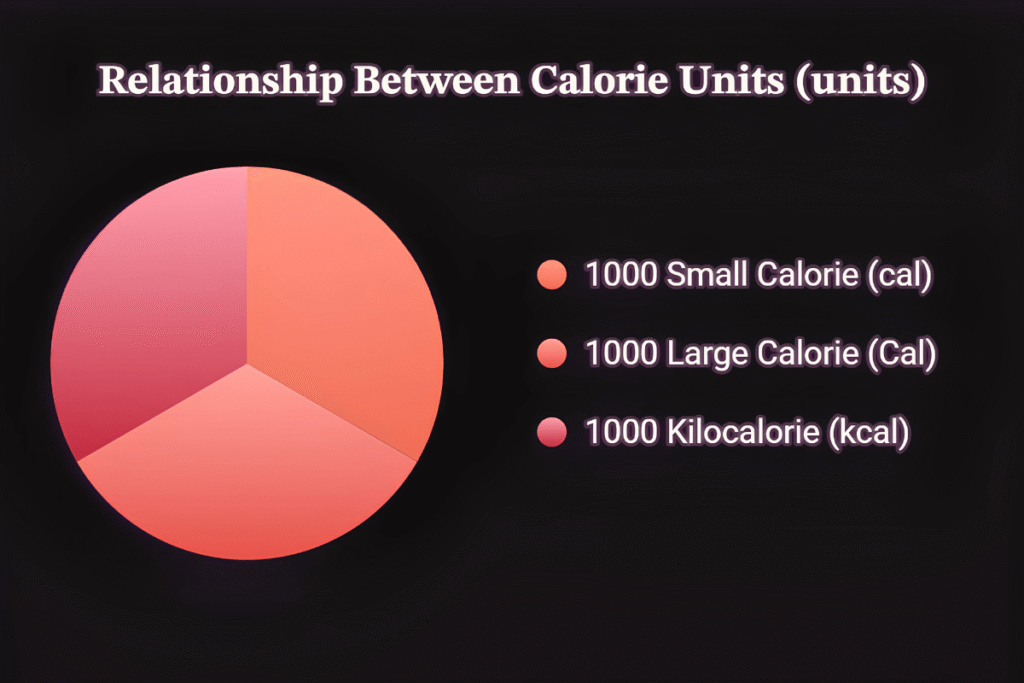
When you see energy in calories on any nutrition tracker, it always refers to kcal, the food calorie. This tool converts kilojoules into that unit, giving you figures that match your diet app exactly. Are calories and kJ the same? No, but they measure the same thing on different scales: 1 kcal = 4.184 kJ.
Daily kJ Targets Australian Reference (NHMRC)
The following figures are general estimates from the Australian Dietary Guidelines, published by the NHMRC. Individual needs vary based on age, height, weight, and activity level.
| Group | Daily kJ | Approx. kcal |
| Adult women (moderate activity) | 8,700 kJ | ~2,079 kcal |
| Adult men (moderate activity) | 10,500 kJ | ~2,510 kcal |
| Women (weight loss target) | 6,000–7,000 kJ | ~1,434–1,673 kcal |
| Men (weight loss target) | 7,000–8,500 kJ | ~1,673–2,032 kcal |
| Children 5–12 years | 6,000–7,500 kJ | ~1,435–1,792 kcal |
| Active adults / athletes | 12,000–15,000+ kJ | ~2,868–3,585 kcal |
For a personalised daily energy target based on your Basal Metabolic Rate (BMR) and activity level, speak with an Accredited Practising Dietitian (APD).
Common Australian Foods: kJ and Calorie Reference
| Food | Serving | kJ | kcal |
| Medium banana | 120g | ~420 | 100 |
| Full-cream milk | 250ml | ~700 | 167 |
| Weet-Bix (2 biscuits) | 30g | ~440 | 105 |
| Vegemite on toast | 2 slices | ~630 | 150 |
| Tim Tam biscuit | 17g | ~360 | 86 |
| Flat white coffee | 250ml | ~540 | 129 |
| Meat pie (snack size) | 175g | ~1,740 | 416 |
| Sausage roll | 130g | ~1,450 | 347 |
Best Apps for Kilojoule to Calorie Conversion in Australia
If you track nutrition on your phone, these are the most recommended options for kJ to cal conversion on the go:
MyFitnessPal: Australia’s most widely used kJ to cal converter app. Set your daily target in either kJ or kcal, and the app converts automatically. Available on iOS and Android.
Cronometer: A detailed calorie and micronutrient tracker. Works as an effective cal to kJ app for users who need to enter calorie-based targets and see kilojoule equivalents on Australian labels.
Lose It!: A clean, beginner-friendly kilojoule to calorie app with a simple interface for tracking daily energy intake.
Easy Diet Diary: Built specifically for Australian and New Zealand users with kJ as the native unit. This is the top-rated kJ to calorie iPhone app for local food databases, covering thousands of Australian supermarket products.
For quick one-off label checks without downloading an app, bookmark this page as your online conversion kJ to cal tool.
Why Australian Food Labels Show kJ Instead of Calories
Australia officially adopted kilojoules as the standard unit for food energy in 1988 as part of the national shift to the metric system. Under FSANZ regulations, all packaged food sold in Australia must display energy in kJ. Some products voluntarily include kcal as well, but it is not a legal requirement.
This creates a practical gap: labels show kJ, but most global diet and fitness apps including MyFitnessPal, Cronometer and Lose It!, display calories. That is exactly what this kilojoule unit converter is designed to bridge.